
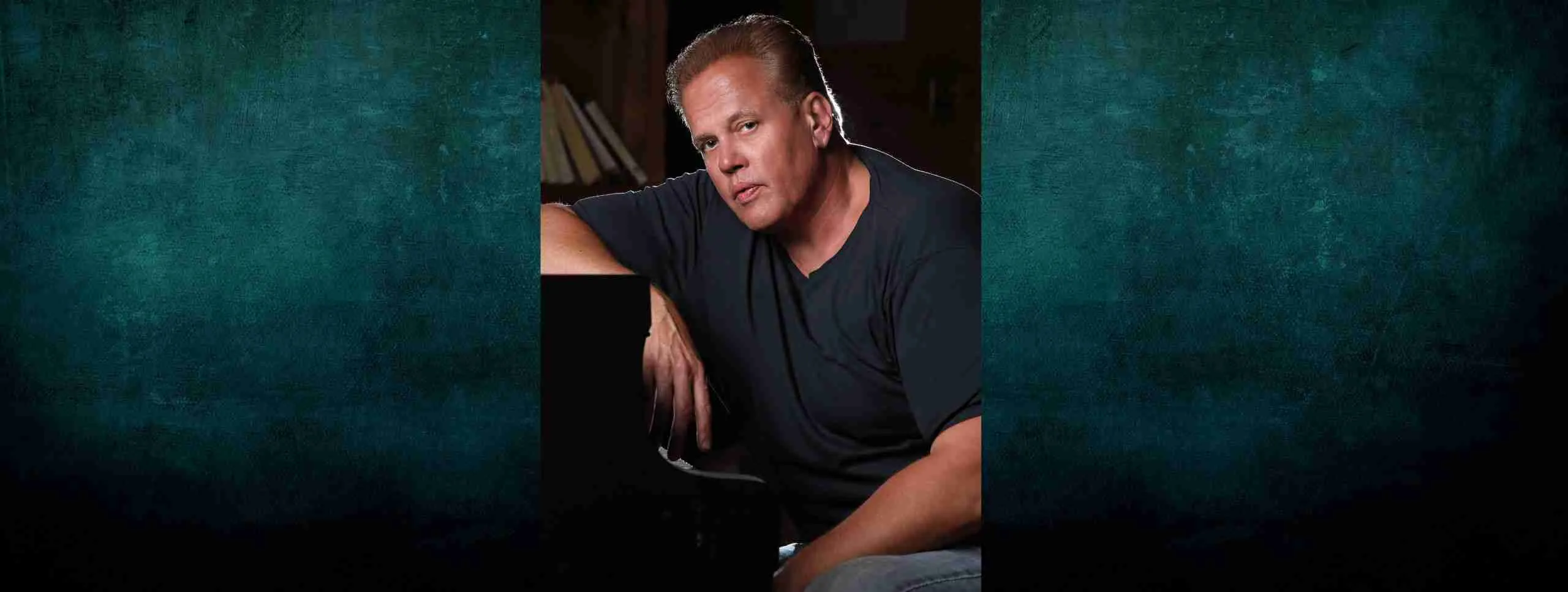
Aaron Copland’s majestic Third Symphony anchors The Florida Orchestra’s latest Hough Family Foundation Masterworks program, but all eyes and ears will be on Tzimon Barto as he sits down this weekend (May 9-10) to play Gershwin’s Piano Concerto in F.
That’s because stereotypes don’t adhere to Barto, who has drawn admiration, and raised eyebrows, for his unconventional style and often extravagant approach to the classics.
A polymath, Barto’s interests stretch far beyond the keyboard. He’s a bodybuilder, novelist, poet, philosopher and advocate of languages – he speaks seven, including Latin. He admits a love for “the slowness of things’’ and to be alone, which allows him to digest books and musical scores. His recordings embrace an eclectic range of composers, from Bach to Ives, Rameau to Pfitzner, Brahms to Bartok. His lifelong project isn’t musical, but literary: engraving his personal writings on granite slabs scattered around his property north of Orlando.
Given his penchants, he likely will add a twist to the Gershwin, notes TFO Music Director Michael Francis: “He’s a world-class star, an amazing artist, and a very thoughtful guy. He also looks like a bodybuilder and could probably lift the piano off the stage.’’
We caught up with the 62-year-old, Florida-born, Juilliard-trained musician – whose real name is Johnny Barto Smith − and asked about his passions and life as a touring pianist.
You live outside of Eustis. That’s not far from the Tampa Bay area where you will be playing.
I was born and raised in Eustis, of which the original meaning in Greek translates loosely as “good grapes.’’ I’m voluntarily sequestered here in an oversized log cabin on 39 acres, which I share with sandhill cranes, gophers, opossums, armadillos and one cat named Molly.
The Washington Post called you “flamboyant.’’ The word means different things to different people.
At the risk of being accused of narcissism, I prefer the epithet, “the Apollo of music,” which the Post threw at me once. “Flamboyant” can be a positive or negative description. One certainly can’t be flamboyant while actually performing because you have to focus on 88 black and white keys and a demanding musical score. Flamboyancy has no longevity − great music does.
You cram a lot into 24 hours, much of it away from the piano.
I live my days according to a strict schedule: Half an hour of weightlifting; half an hour of math; two to three hours of piano practice; six hours writing; an hour of keeping up my ancient languages; an hour of reading; six meals a day; and two free days in the week.
Has body building enhanced your artistry as a pianist?
The only way weightlifting enhances one’s artistry is by enabling one to function physically at the highest level, and to enjoy a long life in which to do so − a life longer than one would have lived had he not exercised.
You say that philosophy keeps you grounded. How?
There is nothing more satisfying than thinking about thinking. The sole difference between homo sapiens and animals is the former’s ability to be aware of awareness. This super- objectivity led to our ability to create symbols (letters, numerals, notes), and consequently, the arts and sciences. I believe if one systematically reads and re-reads a wide variety of philosophy, from ancient to contemporary times, that person will never need to fork out $500 to a psychiatrist.
You have noted a relationship between musical frequencies and the Periodic Table of the Elements. I’m curious what that relationship might be.
When you analogize the four musical intervals in Western music theory with the chemical elements according to their atomic numbers, you’re able to establish a pattern between the intervals and the elements’ spectral lines. This pattern reveals that the elements are actually “signing” their atomic number with their spectral lines.
On another spectral line, what attracts you to the Gershwin concerto you’re about to play?
The pathos. I learned how to play the Gershwin when I was a teen by visiting New Orleans’ Preservation Hall and hearing how one plays the blues. The concerto is all about blues! And one never plays the blues fast.
What do you try to convey to listeners about this work?
The most important thing in any interpretation is how one phrases: a phrase with a beginning, middle and end; a phrase in which no two notes sound alike. That constitutes the musical values I want to impart to the listener. I model all my phrasings in the style of bel canto − beautiful singing.
How many concertos do you keep in your back pocket, ready to play on demand?
I have about 50 concerti in my repertoire. In my back pocket, about 20.
You know a half-dozen languages. How do you keep up with all the nuances?
By reading daily in all of them.
You are involved in a project called Stele, where you literally set your writing in stone monuments in your back yard.
My literary work, the Stele, is part art installation, involving 1,685 granite slabs, or stele. The granite was just ordered from Brazil last week and will need about 18 to 22 months to be delivered to the engraver in Okeechobee. The project should be complete in about five years.
Finally, what is the upside and downside of your work?
The upside: an appreciative audience that’s been moved by my playing. The downside: plane travel. I like to joke that I’m paid not to play, but to travel.
IF YOU GO
Copland’s Symphony No. 3
Featuring Gershwin’s Piano Concerto in F
Fri, May 9, 8 pm, Straz Center
Sat, May 10, 8 pm, Mahaffey Theater
Tickets: FloridaOrchestra.org


Mr. Loft:
Thank you, again, for such a superb and insightful summary of the program, and the extra dialogue with the artist. He loves his craft, and many other “penchants”, so it’s a great story and all should embrace a few hours to take in this talent and enjoy the moment.
We were at the concert on May 9th and really really really enjoyed the performance. We are always amazed with the Michael Francis/ Florida Orchastra score interpretations and this performance did not disappoint us. In fact it was standing room good. Mr. Barto is amazing.
Roger Eha